When my older sister studied abroad during her junior year of college and returned home with a plethora of exciting stories, new memories, and friends from around the world, I knew that I also wanted to spend a semester exploring a different country. I wanted to follow in her footsteps and go out of my comfort zone and try something completely new.
So, during the first month of my junior year, I began to research different places where I could study in the Spring. Fordham has a whole website dedicated to searching their dozens of study abroad programs, meaning that I could study virtually anywhere in the world. Going in, I knew that I wanted to study somewhere in Europe. My sister had studied in India for her semester, and while she really enjoyed it, I wanted to go somewhere that was a little closer to home.
At Fordham, students are required to take four semesters of a language. During my fall semester of my junior year, I was in the process of taking my third semester of French, a language that I took online in high school but because I did not retain any of the information I learned during those three years of French, I essentially had to start from scratch my freshman year of college. Because I still had one semester of French left to take, I wanted to find a study abroad program that would allow me to take French and finish off my four semester requirement so I did not have to worry about it my senior year.
There were several programs in France that Fordham offered, however most of them required students to be fluent in French because classes were taught primarily in French. Although I was good at memorizing French vocab, and I knew how to have a basic conversation, there was no way I was going to be able to take a class in French and understand even half of what was being taught.
Luckily, I came across the study abroad program in Reims, France, where classes are taught in both French AND English. The university, called SciencesPo, is known for its political science classes and many notable French politicians have attended the school. Because SciencesPo checked off both of the options on my list (it had French language classes and regular classes taught in English) I knew that I wanted to attend this university.
Although the language class ended up being much more intensive than I imagined, as there were six hours of French class a week and it was taught exclusively in French, I am so glad that I picked Reims as my home away from home. Because my major is Digital Media, and SciencesPo specializes in political science and history, I was able to take a few classes that did not relate to my major, but ended up being very interesting, such as Entrepreneurship. Ultimately, I am so glad that I chose France as the place to finish off my fourth semester of French. Not only did I get to live with four French roommates and get to practice my French with people on the street and with the very patient woman in the boulangerie everyday, but I also got the opportunity to explore a lesser-known region in France for five months, which proved to be a unique and unforgettable experience. Whether you go to a completely different country like India, or a place closer to home, like France, I guarantee that you too will return home with exciting stories, new memories, and friends from around the world.
Showing posts with label Reims. Show all posts
Showing posts with label Reims. Show all posts
Friday, July 26, 2019

Wednesday, July 24, 2019
A Photographic Portrait of Reims
Here I'll share my favorite pictures of Reims from the well-known buildings to my favorite spots in the lesser known neighborhoods.
These are some of my favorite places in Reims that I walked by every week. I hope this gives you a good look into my daily life in France!
 | |||
| The canal near my apartment—my favorite running spot |
 | |||
| A French apartment next to one of my go-to pizza restaurants |
 |
| A typical French building in the city center |
 |
| A fountain in the city center next to a Super Crepe store |
 |
| A statue/fountain in the city center |
 |
| A close-up view of the statues on the Reims Cathedral |
 |
| The "shopping center" in Reims |
These are some of my favorite places in Reims that I walked by every week. I hope this gives you a good look into my daily life in France!
Tuesday, July 23, 2019
A Guide to Champagne Tours
Since I studied in Reims, which just so happens to be the capital of the Champagne region in France, I knew I just had to take advantage of being in this location. So, towards the end of my time abroad, my parents visited and we went on several champagne tours. Here is my review of the two different houses that we visited.
1. Paul-Etienne Saint Germain—Épernay, France
First, we visited the famous Avenue de Champagne in Épernay. This is essentially a one kilometer long street with Champagne Houses on both sides. Many of the most well-known champagne producers are located here, including Moët, Chandon, and Perrier-Joët. The house that we visited was smaller, and when we walked in we spoke directly to the owners. We chose to sample champagne from their two collections: Les Classiques and Les Prestiges. I tried the Rosé and the Divine St. Germain... both were great. The best part about visiting a smaller house such as this one is that you get a more personalized experience and you get to try a champagne that you probably wouldn't have the chance to in back in the U.S. We liked this champagne so much that we decided to ship two bottles back home to the U.S.!


2. Champagne Taittinger—Reims, France
The second place we visited was actually located about a mile away from my apartment in Reims. If you are looking for more than a simple tasting, I would go to this Champagne House. In addition to a tasting, we also were given a tour of the cellars. This particular tour takes visitors 18 meters below ground where you are given a behind-the-scenes look at the champagne making process and also a history of the Taittinger Champagne House, which was originally an Abbey that housed Benedictine monks! Though the Taittinger brand is more renowned in the United States, I didn't notice a difference in quality between this champagne and the Paul-Etienne champagne. It is worth noting, however, that I think all champagne tastes the same anyways.

These are just two of the many Champagne Houses in the Champagne Provence of France and I am sure that each house presents a different experience to its visitors. Whether you are on the Avenue de Champagne in Épernay or in Reims, you cannot go wrong with any of the houses there. I would recommend looking at availability and booking a tour ahead of time, because people travel from all over the world just to try this champagne, and the tours book up quickly!
1. Paul-Etienne Saint Germain—Épernay, France
First, we visited the famous Avenue de Champagne in Épernay. This is essentially a one kilometer long street with Champagne Houses on both sides. Many of the most well-known champagne producers are located here, including Moët, Chandon, and Perrier-Joët. The house that we visited was smaller, and when we walked in we spoke directly to the owners. We chose to sample champagne from their two collections: Les Classiques and Les Prestiges. I tried the Rosé and the Divine St. Germain... both were great. The best part about visiting a smaller house such as this one is that you get a more personalized experience and you get to try a champagne that you probably wouldn't have the chance to in back in the U.S. We liked this champagne so much that we decided to ship two bottles back home to the U.S.!


2. Champagne Taittinger—Reims, France
The second place we visited was actually located about a mile away from my apartment in Reims. If you are looking for more than a simple tasting, I would go to this Champagne House. In addition to a tasting, we also were given a tour of the cellars. This particular tour takes visitors 18 meters below ground where you are given a behind-the-scenes look at the champagne making process and also a history of the Taittinger Champagne House, which was originally an Abbey that housed Benedictine monks! Though the Taittinger brand is more renowned in the United States, I didn't notice a difference in quality between this champagne and the Paul-Etienne champagne. It is worth noting, however, that I think all champagne tastes the same anyways.

These are just two of the many Champagne Houses in the Champagne Provence of France and I am sure that each house presents a different experience to its visitors. Whether you are on the Avenue de Champagne in Épernay or in Reims, you cannot go wrong with any of the houses there. I would recommend looking at availability and booking a tour ahead of time, because people travel from all over the world just to try this champagne, and the tours book up quickly!
Tuesday, July 16, 2019
Wikipedia Follow-Up
Earlier, I wrote a post about the SciencesPo Wikipedia page and how I changed a section to add more information. Specifically, in a section that described the seven campuses of the university, I added a paragraph about an athletics and arts competition between the campuses that happens at the end of every school year. Because some time had passed since I added to the Wiki page, I wanted to check to see if my addition was still on the page.
When I visited the page again, my modification was deleted. However, there was a message at the top of the page that informed me that my portion was deleted because there was no citation. So, I retyped my change and added it with the citation. Hopefully now that it is properly cited it stays on the page!
When I visited the page again, my modification was deleted. However, there was a message at the top of the page that informed me that my portion was deleted because there was no citation. So, I retyped my change and added it with the citation. Hopefully now that it is properly cited it stays on the page!
Tuesday, July 2, 2019
SciencesPo Wikipedia
As I was doing some research about SciencesPo, my French university, I noticed that its Wikipedia page lacked some important information. Mainly, it gives a description of all seven campuses, but it does not include how these campuses are connected. The original post simply had a headline that said "Campuses" followed by a sentence that read:
Every year, all seven campuses come together to compete in athletic and artistic competitions. I added this fact to the post. It now reads:
I thought that it was important to include this additional information because the students at SciencesPo are very invested in this tournament and emphasize the importance of representing one's campus in the competition. In addition, many of the arts and athletic associations prepare all year for the Minicrit and it is one of the biggest events of the year at SciencesPo. I also thought it was interesting to see that even though all seven campuses are separate and spread throughout France, they all still come together every year for a celebration and friendly competition.
Campuses
Sciences Po has seven campuses in France. [30]
Every year, all seven campuses come together to compete in athletic and artistic competitions. I added this fact to the post. It now reads:
Campuses
Sciences Po has seven campuses in France. Every May, at the end of the academic year, all seven campuses come together for the inter-campus Collegiades de SciencesPo tournament, also known as the MiniCrit. At the tournament, students represent each campus and compete against one another in arts and athletic competitions. Different events include athletic games such as volleyball and football, as well as artistic competitions such as dance and singing.[30][31]
I thought that it was important to include this additional information because the students at SciencesPo are very invested in this tournament and emphasize the importance of representing one's campus in the competition. In addition, many of the arts and athletic associations prepare all year for the Minicrit and it is one of the biggest events of the year at SciencesPo. I also thought it was interesting to see that even though all seven campuses are separate and spread throughout France, they all still come together every year for a celebration and friendly competition.
Tuesday, June 25, 2019
The Reims Cathedral
After the initial culture shock of living in Reims, I began to get used to my new surroundings, such as walking on the cobblestone streets, passing by the ancient French buildings, and hearing the chatter of old French couples as they took their daily stroll through the neighborhood. But the one thing that I never truly got used to seeing was the Reims Cathedral.
For such a small town, Reims has a lot of history–the Cathedral is just one example, but perhaps the most well known. The "Cathédrale Notre-Dame de Reims" was built in the 13th century and was used as the site to crown French kings starting with Louis VIII in 1223 until Charles X in 1825.
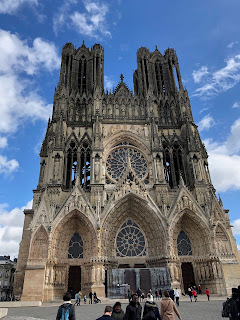
The Cathedral itself is massive as it stands over 200 feet tall and is almost 500 feet long.

The facade of the Cathedral is my favorite part because it is decorated with 2300 intricate statues of biblical figures and kings.

The inside of the building is equally as breathtaking. There are stained glass windows throughout, including the rose windows, depicted above, that were saved when the Cathedral was bombed during World War I.
I walked by this Cathedral at least once or twice a week, but every time I turned the corner and saw it, I had to take a second to appreciate this magnificent building that towers over the city of Reims.
[Sources: Walking on Travels, France.fr, Encyclopaedia Britannica, and The New York Times].
For such a small town, Reims has a lot of history–the Cathedral is just one example, but perhaps the most well known. The "Cathédrale Notre-Dame de Reims" was built in the 13th century and was used as the site to crown French kings starting with Louis VIII in 1223 until Charles X in 1825.


The facade of the Cathedral is my favorite part because it is decorated with 2300 intricate statues of biblical figures and kings.

The inside of the building is equally as breathtaking. There are stained glass windows throughout, including the rose windows, depicted above, that were saved when the Cathedral was bombed during World War I.
I walked by this Cathedral at least once or twice a week, but every time I turned the corner and saw it, I had to take a second to appreciate this magnificent building that towers over the city of Reims.
[Sources: Walking on Travels, France.fr, Encyclopaedia Britannica, and The New York Times].
Subscribe to:
Posts (Atom)